


The famous labor shortage, which has been the topic of conversation since 2018, now seems to be behind us. But beware, while the world of work has already evolved in 2024, certain indicators show that recruitment difficulties could well continue into 2025!
In this context, what should we focus on? We often talk about promoting the employer brand, rethinking the candidate experience, offering better working conditions… These are certainly relevant recommendations. But let’s be honest: all of this is just hot air if we don’t include hiring managers in our recruitment strategies.
In short, every time we recruit, we must take into account the needs of the organization, those of the candidates, and our own. The quality of a hire will depend on how these elements are aligned. This is what we call the hiring ecosystem.
Understanding your ecosystem: who does what and how?
The hiring ecosystem first helps us understand who the key players are, what their respective roles are, and how they interact with each other. It then allows us to take into account the external and internal forces that influence the success of our hires.
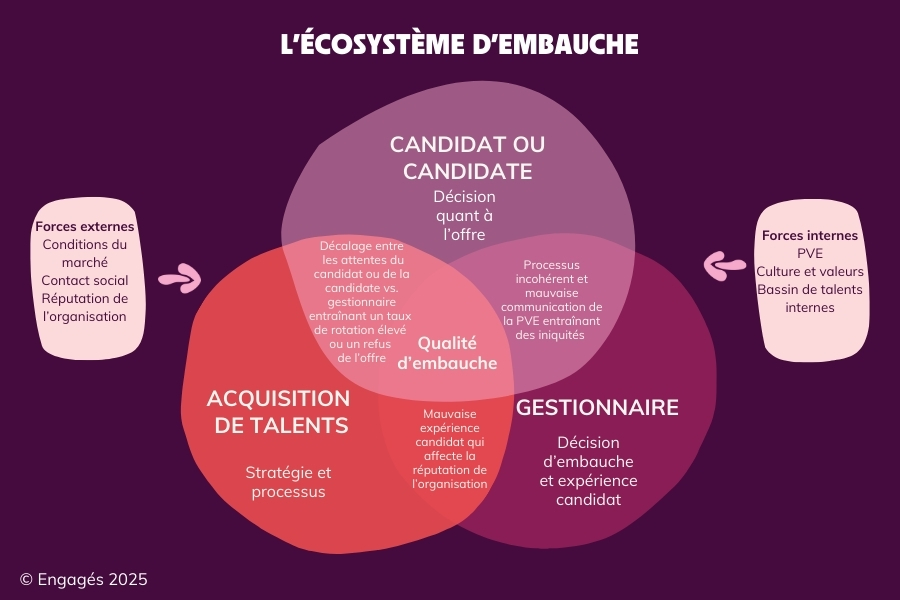
External forces are related to market conditions: the availability of talent, demand for certain skills, the scarcity of certain profiles, and competition for the same candidates. Although these factors are often beyond our control, they must be taken into consideration.
Internal forces, on the other hand, include the employee value proposition (EVP): what the organization has to offer in terms of salary, benefits, career opportunities, culture, and values. These internal elements have a direct impact on the organization’s ability to attract qualified profiles.
The role of hiring managers
Generally, HR is responsible for highlighting these internal strengths. But often, managers—who are at the heart of the hiring ecosystem—are not sufficiently involved from the outset.
Let’s take an example: thousands of dollars are invested in an employer branding project or to improve the recruitment process. We make sure we have the best attraction strategies and a solid process in place. But if managers don’t play their part properly, we end up with what is known as the recruitment blind spot.
When a manager is unable to clearly define their needs, rejects applications without valid reasons, or makes decisions based solely on instinct, there is a direct impact on the quality of hires, not to mention the risks to the organization’s reputation.
Who makes the final decision?
Let’s return to the question: who really decides? Recruitment teams are there to provide their expertise in strategies, practices, and procedures. But the final decision rests with managers.
When we know that a bad hire is costly, with a high turnover rate (80% of departures are linked to bad hires, according to the Harvard Business Review!), it becomes crucial for managers to act as true strategic partners to ensure sustainable hires.
Some managers understand the importance of recruiting not only for the position, but also for the team and the organization. They already understand this dynamic and naturally act as strategic partners in recruitment. These managers clearly define their needs, are open to different profiles (transferable skills, atypical profiles), and are proactive in the process. But let’s be realistic: not all managers are like that. This is where we, in HR, need to step in to guide and support them.
***
Recruitment challenges cannot be solved by applying a single solution. But whatever actions we take, it is essential to involve managers from the outset and ensure that they are aligned with our recruitment strategies. It is by transforming them into true strategic partners that we will achieve the positive impact we are seeking.
Ultimately, this will not only enable us to attract and retain the best talent, but also strengthen our organization’s reputation as an employer of choice. And that’s the ultimate goal, isn’t it?