


True or false: When you post a job, the aim is to receive as many applications as possible, since there’s bound to be one that fits the bill.
Untrue.
What counts is not the quantity, but the quality of the applications received. When you think about it, we need to attract just one candidate, but the right one – the one we want to make an offer to!
So how do we write a posting that will attract the right person?
First of all, a job description is not the same thing as a job posting! Generally speaking, a job description is an internal document detailing the role, responsibilities and requirements of the position, but it’s often very formal and uninviting to candidates. It’s therefore important to review the job description and make it into an attractive display for candidates.
To do this, put yourself in the shoes of the targeted candidates. Most job postings are written from the employer’s point of view, so the information is presented in an order that respects their interests. However, if you want to pique the curiosity of potential candidates and encourage them to continue reading your posting, you need to display the information most relevant to them first! We call this the Inverted Pyramid.
***
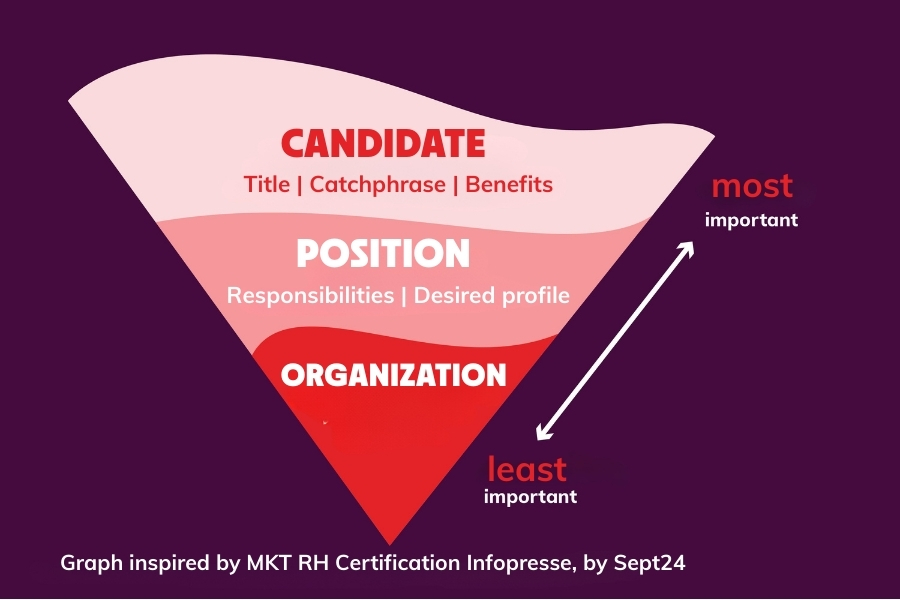
So, rather than talking about your organization and the position first, start by presenting the information that particularly appeals to candidates, such as the benefits of the position, the mandate and the challenges.
Here are the different content sections of an ideal job posting in more detail:
1. The title, or how to pique candidates’ curiosity
The title is the first thing candidates see. It must allow them to recognize themselves in it, and entice them to click on the link to read the posting.
Here are a few tips to help you achieve this:
- Explore the different posting sites to make sure you use an appropriate title for your industry.
- Don’t get too creative, as your posting may fall under the radar of keywords used by job seekers (and please, forget “ninjas” and “gurus”!).
- Don’t use any internal jargon that would be opaque to candidates; by the way, the title doesn’t have to match the job title you use internally.
- Keep your job title to less than 60 characters, so that it displays well on a computer screen, and to no more than 35 characters for mobile display.
- Repeat the job title at least 3 times in the job posting to increase its visibility on search engines.
2. The introduction with an original catchphrase
After clicking on your job posting, candidates should want to keep reading.
Here’s how to get off on the right foot and get your posting off to a good start:
- Start with a catchy sentence to make candidates want to know more. This technique is called a hook, for obvious reasons! For example, for a position in factory production, a hook might go something like this: “You’re constantly called upon to lend a hand with a leaking dishwasher, an overheating hair dryer or a loose bicycle chain? Are you resourceful? Our team is waiting for you!”
- Another option is to summarize the high-level position (mission and overall objective) in 1 or 2 sentences.
3. The benefits of the position
It’s time to set yourself apart. What do you offer that’s more or better than the others, or at least what do you offer that’s particularly interesting?
Here are a few topics to talk about with pride:
- Hybrid work arrangement – group insurance – RRSP contribution – comfortable workspaces – financial participation in transportation costs – advantageous paid leave – social events – training program – passionate and committed team – benefits such as discounts – etc.
4. The tasks
All too often, less well-crafted job postings have the flaw of presenting the tasks and profile required according to the organization’s posting standards, rather than actually addressing the candidates. Remember that this section of the job posting should allow candidates to project themselves into their future position. To this end, it’s a good idea to make everything as concrete as possible, for example, by addressing the problems of the position, the frequency with which a task must be performed, or the percentage of time staff must devote to it.
Here are a few guidelines for writing a good job description:
- Explain why we’re recruiting and why we’re looking for the profile described.
- Indicate to whom in the organization the position reports.
- Use action verbs to describe responsibilities.
- List tasks in order of importance to the job.
- To make the position attractive, describe the responsibilities of the person who will occupy it (cover indicators, clientele, projects, etc.), his or her role and impact on operations.
- Indicate how this person’s work will be evaluated.
5. Desired candidate profile
As for the profile of the candidate you’re looking for, stick to the essential criteria (a maximum of 5 to 8). No matter whether you call them “experience and skills”, “qualifications” or “prerequisites”, too long a list can discourage candidates and be particularly detrimental to the the hiring of women).
Please also bear in mind the following tips:
- Remain realistic and flexible so as not to scare candidates away.
- When it comes to technical and behavioral skills, distinguish between an indispensable requirement and an asset.
- Consider transferable skills.
6. The call to action
Without clear guidelines, you’ll lose candidates – it’s as simple as that. So:
- Clearly highlight the tools to be used to attach a CV, cover letter, portfolio, etc.
- Indicate whether you need to apply by e-mail or on an exclusive platform, and mention the name of the person responsible for recruitment.
It’s also a good idea to indicate here how the application and selection process will be handled. Be transparent.
7. Profile of the hiring organization
You want to know who you’re dealing with; the reverse is also true, since the relationship is a two-way street. So be sure to give an overview of your organization, its culture, values and mission. But above all, be realistic and sincere! If you create false expectations, you won’t make a lasting hire.
It’s also a good idea to indicate here how the application and selection process will be handled. Be transparent.
7. Profile of the hiring organization
You want to know who you’re dealing with; the reverse is also true, since the relationship is a two-way street. So be sure to give an overview of your organization, its culture, values and mission. But above all, be realistic and sincere! If you create false expectations, you won’t make a lasting hire.
And if possible, include your organization’s logo and a link to your website.
***
Finally, also follow these valuable tips to maximize the success of your job posting:
- Use simple vocabulary that everyone can understand.
- Limit the length of your job posting to 3,500 characters, or even less for an optimal mobile format, and test it to limit to 5 the number of swipes it takes to get to the “Apply” button.
- Seek external advice.
- Optimize SEO by identifying the right keywords to use (using Google Trends, for example) and using them in the title of your ad, but also in any sub-headings, text portions and titles of attached images or videos.
With all these tricks up your sleeve, there’s no reason why your job posting shouldn’t be as successful as you’d hoped!
Note: Some job boards don’t allow you to put the information in the order you want. Check this before writing your ad!